
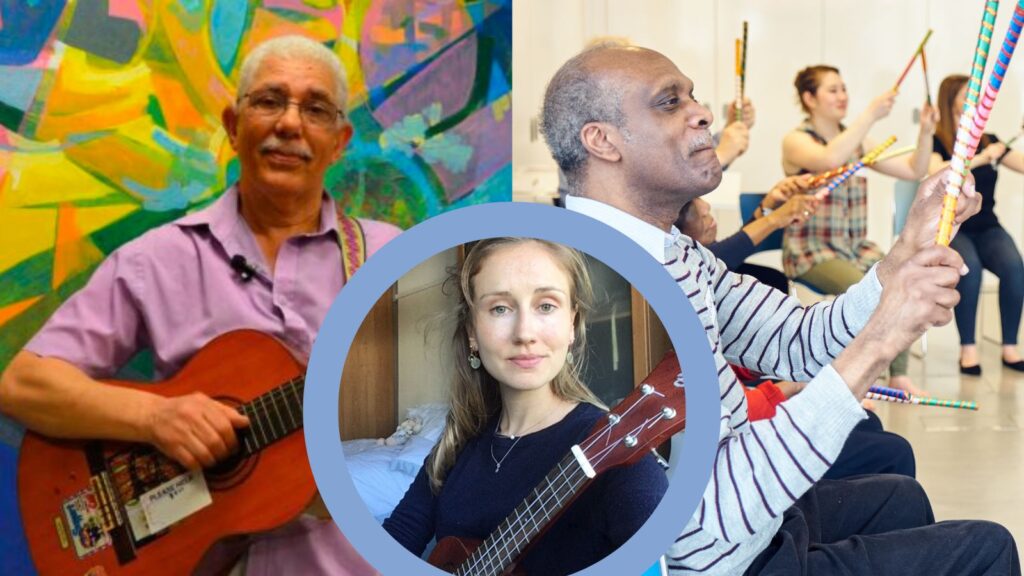
Following the success of the Arts 4 Dementia and Ashford Place music-making programme with musicians Alex D Great and Kate Millet in a Calypso and Irish Folk song fusion. Where each session was focus on a different theme, inspiring the music for that day. Participants experimented with different sounds, instruments and memories around the theme of a smile, (AKA the box of smiles agenda ) to compose their own songs. Expect discussion, participation and even some singing and dancing!f
The last 30 minutes of each workshop will provided time to reflect and socialise, with tea, coffee and light refreshments.
The workshops were aimed at those living with early-stage dementia there carers friends and family. Where also welcome to attend with a companion – whether a friend, family member or carer. No previous experience was required. It was all about giving it a go!
And the workshop was free of charge.
- Enjoy weekly creativity
- Make new social connections
- Develop new skills
- Combat memory worries
Please note:
- To participate, you will need to register by phone in advance.
- Numbers are restricted so, if you may be interested in joining us, please email emily@arts4dementia.org.uk or call 020 3633 5401 as soon as possible.
- We regret that we can only accommodate those who expect to be able to attend all 6 sessions from October 27 – December 1.
A4D Music works.
How music can support your well-being
Music plays a big part in our lives.
Research suggests that music can stimulate the body’s natural feel good chemicals (e.g. endorphins, oxytocin). It can help energise our mood and provide an outlet for us to take control of our feelings. Music can even help us work through problems in our lives.
For example music can help us to:
- Manage stress
- Express feelings
- Enhance memory
- Improve communication
- Promote wellness
- Promote physical rehabilitation
- Alleviate pain (Did you know that focusing on music reduces your brain’s perception of pain?)
Listening to music is a popular way to cope with difficult times. For example, it can sometimes express how we are feeling or vent difficult thoughts and emotions for us. You may be able to relate to the music and find comfort from the words in a song.
By
Music is increasingly recognised as a resource for people living with dementia, and in some cases, their family members and care as who support them with informal care. Several systematic have synthesised evidence importance and the efficacy of music-based interventions in dementia care
Benefits of singing for health and well-being have been reported for the general population
Stimulating memories and inspiring new experiences through creative and the arts. Providing a place where people can come and be happy and upbeat about it.
We began with poetry because the physical features of this form of creative writing—the shape of verse on the page, the frequent use of rhyming and poetic words—make it possible to locate works that are not explicitly identified as poetry in other ways and comfortable for all set of our communities to engage.
———————
It encourages people to explore fresh ways of thinking which
are good for health and unifying communities
What are Cognitive Benefits?
In short, a cognitive benefit improves brain function or mental health. It could be that you become a more efficient problem solver or simply relieve some stress. Engaging in activities that promote cognitive benefits can help to prevent mental health conditions such as depression, whilst also reducing the likelihood of developing dementia.
Creative writing’s cognitive benefits are plentiful. This is because writing, especially in an imaginative sense, forces you to use your brain in a different – yet still familiar – way. You have to look at things differently and put careful consideration into your choice of words. Plus, the satisfaction of finishing a piece of writing releases dopamine, which improves mood as well as motor and brain functions.